
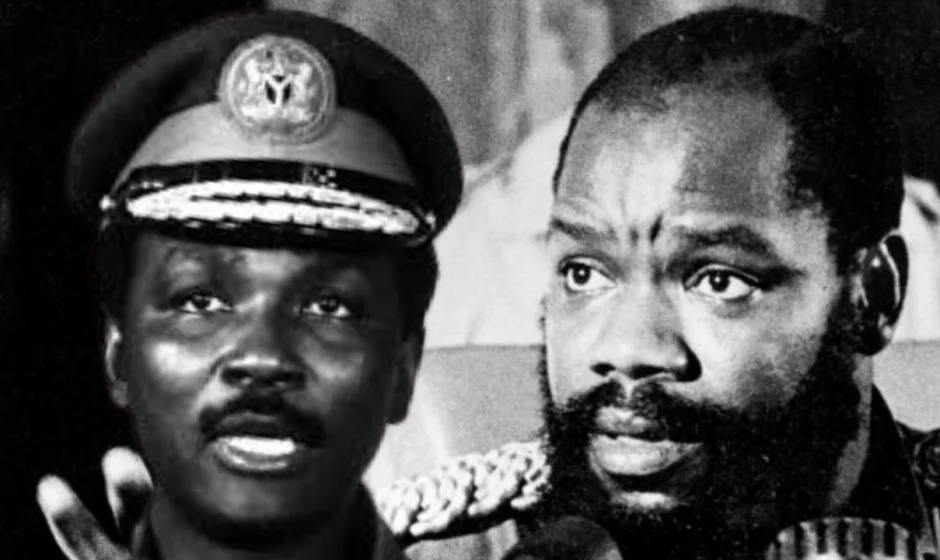

Former Head of State, Gen Yakubu Gowon (retd.), has blamed the late Biafran leader, Lt Col Odumegwu Ojukwu, for the failure of the landmark Aburi accord of January 1967.
He accused the secessionist leader of attending the peace meeting in Ghana with pre-prepared positions and misrepresenting the outcome of the discussions to the people of the Eastern Region.
Gowon also said Ojukwu had been secretly building up arms while mocking him as a “Bible-carrying” officer who would never fight.
He made this known in Chapter Nine of his 859-page autobiography, “My Life of Duty and Allegiance,” launched in Abuja on Tuesday.
In the 37-page chapter, which was both his historical account and a personal reckoning of the meeting, Gowon blamed Ojukwu’s conduct in the months before the Aburi meeting.
He said, “Ojukwu deliberately and effectively thwarted every effort we made to amicably resolve all vexing national issues. He refused to meet with other members of the SMC (Supreme Military Council) in Benin, the capital of the Mid-West Region, which we all knew was neutral in the brewing crisis.
“He was not favourably disposed to any proposed meeting, whether in the air aboard a BOAC aircraft, the Royal Navy Cruiser, or any neutral carrier.
“He declined about every proposition and dismissed invitations to meet with me and other members of the Supreme Military Council ‘anywhere in Nigeria where there are Northern troops.’”
Gowon wrote that at a purely personal level, he was certain Ojukwu was playing a mind game with him, driven not by genuine regional grievances but by personal ambition, an ambition for which, he said, the crisis had become a convenient justification.
He recalled being told by the Attorney-General of Nigeria, Dr Taslim Elias, that Ojukwu had, while at Oxford, authored a paper strongly arguing that future power in Africa lay with the military.
Gowon also recounted how Ojukwu privately dismissed him to his subordinates in the lead-up to the Aburi meeting.
“He only saw me as a Bible-thumping ‘Jack’ who, before anything else, would pick up his Bible and pray rather than stand up to fight.
“He liked to say, more or less: ‘Oh, Jack Gowon! He’s only a staff officer who never commanded troops; he’s no threat; he’ll never fight. Do you know what he carries first in his suitcase? It is only the Bible!” he wrote.
The Aburi meeting, Gowon wrote, was brokered after Ojukwu eventually softened his stance following entreaties by the United Nations, the Commonwealth and several friendly countries.
Both sides had agreed that participants would be only the principal military officers in government, with no set positions to constrain the discussions.
The objective was purely exploratory, to break the ice, remove the veil of suspicion and engender trust, he noted.
But according to Gowon, the first signs of trouble became visible shortly after the Nigerian delegation arrived in Accra.
He writes, “I was reliably informed that a phalanx of civil servants from the Eastern Region had accompanied Ojukwu to Aburi.
“This certainly was against the spirit of our prior agreement that the meeting be made a strictly military affair. I was not perturbed by the blatant breach of our gentleman’s agreement.
“I told the officials who accompanied us not to worry because we would stick to what I had agreed with Ojukwu to make Aburi happen.”
He said the breaches continued inside the meeting room itself, as barely had the session been called to order when Ojukwu produced a fundamental aide memoire that had been purposely prepared in utter disregard of their said initial agreement.
“To avoid causing the meeting to be deadlocked before it got off the ground, I decided against insisting on the agreement or reminding him of our word against set positions.
“Doing either would have brought all our efforts over the past few months to nought. Instead, I made a joke that he had brought his ‘Pink Papers,’” he narrated.
Gowon wrote that even as Ojukwu moved the motion that all parties renounce the use of force, a motion the SMC was happy to endorse, he and his colleagues were well aware it was a delaying tactic designed to buy time for a secret arms build-up that had already suffered a setback.
“We were also mindful that he had cleverly planned to apply the brakes on our ability to deploy the numerical advantage of the existing firepower of the Nigerian Army in the event of an immediate outbreak of hostilities.
“We knew he was compelled to buy time because his surreptitious arms build-up had suffered a serious setback in October 1966 with the crash in the hills of Northern Cameroons of the DC-4 aircraft with which he had hoped to smuggle in a cache of arms,” said Gowon.
Nigeria’s former military Head of State, Yakubu Gowon, has said no agreement was reached at the Aburi meeting to allow the Eastern Region to secede and establish Biafra, contrary to claims made by the then Eastern Region leader, Chukwuemeka Odumegwu Ojukwu, in the build-up to the Nigerian civil war.
Gowon, who ruled Nigeria between 1966 and 1975, said he was shocked to hear Ojukwu telling people in the Eastern Region that both parties had agreed to partition Nigeria so that each region could go its separate way following the Aburi meeting held in Ghana on 4 and 5 January 1967.
The former Nigerian leader gave the account in his autobiography, “My Life of Duty and Allegiance,” launched in Abuja on Tuesday.
The event, chaired by former President Goodluck Jonathan, was attended by prominent Nigerians, including President Bola Tinubu, who was represented by his deputy, Kashim Shettima.
By May 1967, at a meeting in Enugu with a National Conciliation Committee delegation comprising Obafemi Awolowo, Prof Samuel Aluko, Jereton Mariere and J.I.C. Onyia, Ojukwu, he stated, dropped all pretence, declaring that the East had attained equality of arms.
Gowon quoted him directly, stating, “‘Quietly I built up. If you do not know it, I am proud, and my officers are proud, that here in the East we possess the biggest army in Black Africa. I am no longer speaking as an underdog; I am speaking from a position of power.’”
Source: Punch Newspaper