

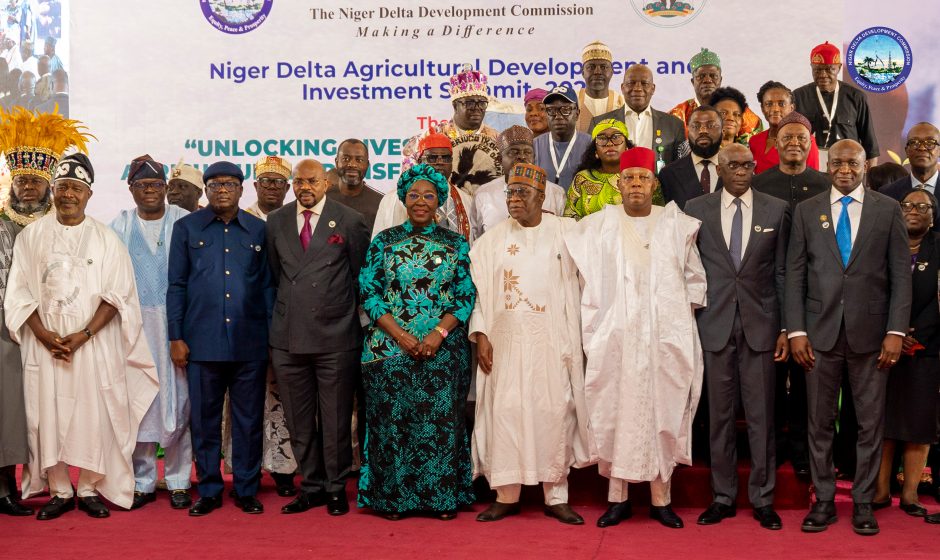

Vice President Kashim Shettima has launched the Niger Delta Agricultural Development and Investment Fund and inaugurated a Coordinating Council to drive agricultural development and investment across the Niger Delta region.
According to a statement by Seledi Thompson-Wakama, Director, Corporate Affairs, the Vice President unveiled the initiative during the Niger Delta Agricultural Development and Investment Summit held at the Banquet Hall of the Presidential Villa, Abuja, noting that it aligns with President Bola Ahmed Tinubu’s Renewed Hope Agenda aimed at promoting agriculture, strengthening food security, creating jobs and diversifying Nigeria’s economy.
The summit, jointly organised by the Office of the Vice President and the Niger Delta Development Commission (NDDC), with the support of the governors of the nine Niger Delta mandate states, was themed, “Unlocking Investment for Sustainable Agricultural Transformation in the Niger Delta.”
Addressing participants, Shettima said the summit would mobilise the collective commitment of government, investors, development partners and the private sector to transform the Niger Delta’s vast agricultural potential into measurable economic growth.
He stressed the need for Nigeria to return to agriculture as the foundation of its economic development, saying, “Before oil took centre stage in our economy, it was the soil that paid our bills. We must, therefore, return to agriculture for our economic development.”
Minister of Regional Development, Engr. Abubakar Momoh, urged investors to look beyond the Niger Delta’s oil and gas resources, describing the region as a major contributor to Nigeria’s food security. He added that mechanised and innovative farming remains central to the Tinubu administration’s agricultural agenda.
Chairman of the NDDC Governing Board, Chiedu Ebie, said the Niger Delta, though widely known for oil and gas, is also richly endowed with fertile land suitable for large-scale agriculture. He noted that the Commission remains committed to supporting the Federal Government’s priorities on food security, poverty reduction and job creation.
In his welcome address, NDDC Managing Director, Dr Samuel Ogbuku, reaffirmed the Commission’s commitment to changing the development narrative in the oil-producing region through agriculture.
He said the summit supports the Renewed Hope Agenda by promoting economic diversification, improving food security and creating employment opportunities across the Niger Delta.
Ogbuku also highlighted the importance of infrastructure in agricultural development, announcing that the NDDC would soon complete the 1.2-kilometre Kaa-Ataba Bridge linking Khana and Andoni Local Government Areas of Rivers State to improve connectivity and facilitate economic activities.
Representing the Minister of Agriculture and Food Security, Senator Abubakar Kyari, the Permanent Secretary in the ministry, Dr Marcus Ogunbiyi, reiterated the Federal Government’s commitment to ensuring food security through a transition from subsistence farming to mechanised agriculture.
Delivering the keynote address titled “Niger Delta: Awakening an Agricultural Giant,” Prince S. J. Samuel also called for the adoption of mechanised farming to unlock the region’s agricultural potential.
Akwa Ibom State Governor, Pastor Umo Eno, represented by Deputy Governor Senator Akon Eyakenyi, commended the collaboration between the Office of the Vice President and the NDDC in organising the summit and reaffirmed the state’s commitment to revitalising agriculture in the region.
Also speaking, NDDC Executive Director, Projects, Dr Victor Antai, said strong partnerships would be essential to driving and sustaining the agricultural development and investment initiatives discussed at the summit.
Earlier, NDDC Director of Agriculture and Fisheries, Dr Winifred Madume, said the Niger Delta possesses fertile land, abundant freshwater resources, diverse ecological zones and extensive waterways that make it well positioned for crop production, aquaculture, livestock, agro-processing and agricultural trade.
She added that the region’s agricultural transformation is not only about increasing food production but also about building a modern agribusiness economy that attracts investment, creates jobs, drives industrial growth and positions the Niger Delta as one of Nigeria’s leading destinations for agribusiness.