
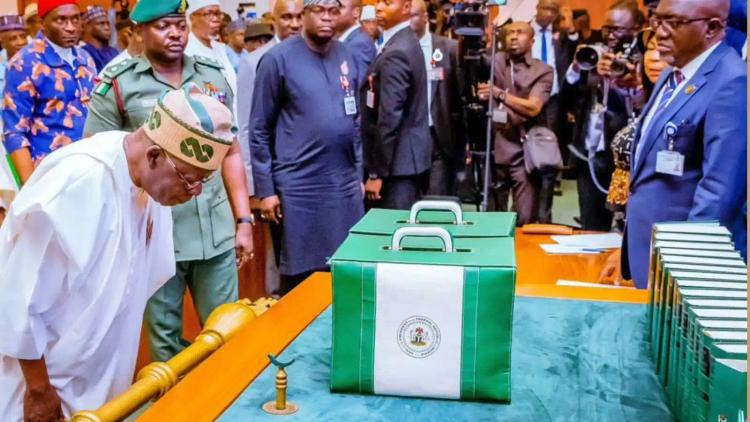

President Bola Ahmed Tinubu on Thursday, December 12, 2025, presented the ₦58.18 trillion 2026 Appropriation Bill to a joint session of the National Assembly in Abuja.
The presentation was attended by top government officials, including Senate President Godswill Akpabio, Speaker of the House of Representatives Tajudeen Abbas, and the National Chairman of the All Progressives Congress (APC).
Tagged “The Budget of Consolidation, Renewed Resilience and Shared Prosperity,” the proposal aims to sustain recent macroeconomic gains, strengthen investor confidence, and convert economic recovery into jobs and improved living standards for Nigerians.
Addressing lawmakers, Tinubu described the moment as “defining” in Nigeria’s reform journey. He acknowledged the hardships caused by economic reforms over the past two and a half years but assured citizens that their sacrifices were yielding results.
According to the president, Nigeria’s economy is showing signs of stabilisation, with GDP growth of 3.98 percent in the third quarter of 2025 and inflation moderating for eight consecutive months to 14.45 percent in November 2025. He also cited improved oil production, stronger non-oil revenues, and rising investor confidence.
Tinubu disclosed that Nigeria’s external reserves had risen to about $47 billion as of mid-November 2025, the highest level in seven years, providing over 10 months of import cover.
Under the budget proposal, total revenue is projected at ₦34.33 trillion, while total expenditure stands at ₦58.18 trillion. Debt servicing will account for ₦15.52 trillion, recurrent (non-debt) spending ₦15.25 trillion, and capital expenditure ₦26.08 trillion. The projected budget deficit of ₦23.85 trillion represents 4.28 percent of GDP.
The budget is based on key assumptions, including a crude oil benchmark of $64.85 per barrel, daily oil production of 1.84 million barrels, and an exchange rate of ₦1,400 to the dollar.
Security received the largest sectoral allocation at ₦5.41 trillion, followed by infrastructure with ₦3.56 trillion, education with ₦3.52 trillion, and health with ₦2.48 trillion.
Tinubu announced a reset of Nigeria’s national security strategy, declaring that all armed groups operating outside state authority would be designated as terrorists. He warned that financiers, arms suppliers, ransom facilitators, and individuals offering political or community protection to violent groups would also face prosecution.
On budget implementation, the president admitted that the 2025 budget faced challenges, noting that by the third quarter, only 17.7 percent of the capital budget had been released. He pledged stricter discipline in 2026 and directed ministries, departments, and government-owned enterprises to meet revenue targets, supported by full digitisation to block leakages.
Tinubu also highlighted increased investment in human capital, revealing that over 418,000 students had benefited from the Nigerian Education Loan Fund. He added that health spending accounts for six percent of the total budget, excluding liabilities, with more than $500 million in prospective U.S. grant funding expected for targeted health interventions.
Agriculture, he said, would be prioritised through mechanisation, irrigation, climate-resilient farming, improved storage, and agro-value chains to enhance food security and boost smallholder incomes.
“The greatest budget is not the one we announce, but the one we deliver,” Tinubu said, expressing confidence that cooperation between the executive and legislature would ensure effective implementation of the 2026 budget.
He concluded by formally laying the Appropriation Bill before the National Assembly and reaffirming his administration’s commitment to the Renewed Hope Agenda.